Tuesday, 18 November 2014

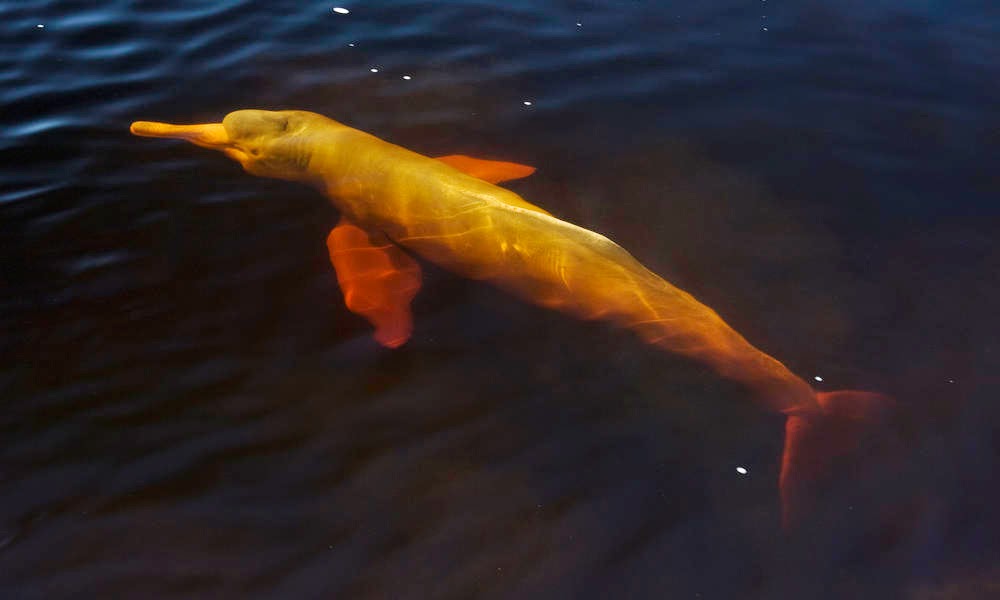
Species of the week: Amazon river dolphin

Species of the Week:
Amazon River Dolphin ( Inia geoffrensis)

  1. As the name implies the Amazon River Dolphin is found in freshwater systems in Brazil, Peru, Bolivia. Venezuela, Ecuador and Colombia. It's found in the river systems of the Orinico in the Amazon and the  Araguaia/Tocantins rivers.
  2. They are either colored light grey or pink which makes then unusual for cetaceans 
  3. It's the largest freshwater cetacean and can grow from 1.53-2.5 m and they weigh from 80-95kg. Females tend to be larger than males.
  4. They feed on fish and crusteceans and small turtles.
  5. They are specialised in hunting in murky waters and have really flexible necks and spinal cords in order to hunt and forage in underwater tree trunks.
  6. Their neck has an unfused neck vertebrate which allows them to turn their head 90 degrees and hence makes them highly flexible.
  7. Calves are born between July and September and usually one calf is born at a time.
  8. Gestation period lasts from 9 to 12 months.
  9. These dolphins are mostly blind, relying heavily on the sonar abilities to hunt for prey. More than usual dolphins do.
  10. Although originally considered Vulnerable by the IUCN Red List, due to the lack of data they are now not classified. However many believe that they are in extreme danger due to habitat loss.

Monday, 10 November 2014

Species of the week:Meerkat

Species of the Week:
Meerkat (Suricata suricatta)


  1. They are found in the Kalahari Desert, in the Namib Desert, southwest Angola and in South Africa.
  2. A Meerkat social group consists of about 20 members and it is called a clan, gang or mob.
  3. Meerkats hunt and forage during the daytime and sleep during the night.
  4. They are mostly insectivores but will attack and eat lizards,fungi, small mammals, eggs, scorpions, centipedes and millipedes, spiders and some plants.
  5. They are immune to a variety of venoms including the scorpion venom of the Kalahari desert.
  6. When Meerkats forage there is always one member of the clan that has sentry duty and looks out for predators. When one is spotted, the meerkat sounds the alarm and all the other clan members go into hiding.
  7. Meerkats can reproduce throughout the year but prefer warmer seasons to give birth too. Usually only the matriarch gets to breed however in larger groups for subordinate meerkats may secretly breed. These females are often chased away from the group and form their own clan.
  8. One to five pups are born with the most common number being three pups.
  9. Meerkats have been found to demonstrate altruistic behaviour and will often look after young that are not their own.
  10.  Meerkats are considered "Least Concern " under the IUCN Red List.

Sunday, 2 November 2014

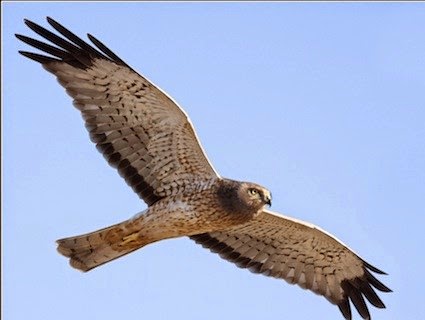
Species of the week: Hen Harrier

Species of the week:
Hen Harrier(Circus cyaneus)


  1. They can be found in the Northern Hemisphere, in Northern Europe and Northern U.S.A and Canada.
  2. Hen harriers have  sexual dimorphism in their appearance. Males are pale grey//white while females are brown.
  3. They are about 40-52 cm long and has a wingspan of 97-122cm.
  4. They feed on small mammals and small birds and live in open areas.
  5. Hen harriers are migratory birds, migrating South for the winter. If they opt to stay at certain countries due to mild climate, they generally just migrate to lower altitudes.
  6.  It lays from four to eight eggs and the eggs are incubated from 30-32 days.
  7. The chicks become fledgelings at around 35-36 days old but do not fully mature until they are 2 years old if female or 3 years if male.
  8. They are the only hawk-like bird to practise polygyny.
  9. The males maintain a large territory in which they can be responsible for up to five females.
  10. They are considered "Least Concern"by the IUCN red list but in specific areas such in the U.K they are regarded as under threat due to human conflicts as gamekeepers shoot them since they influence Red Grouse populations.

Wednesday, 22 October 2014

Updates and blog organisation


So it's been about a month since I returned back to Aberdeen. Ever since then I have been struggling to get back to the normal routine since my dissertation and review essay are taking most of my time. This is a little post to just remind you that I am still active. Species of the week will return this Sunday and I will attempt to post something at least once a week apart from the Species of the Week.
Thank you so much for reading

Sunday, 5 October 2014

Wolf Science Center final thoughts


It's been a week since I left the Wolf Science Center. Since that week I managed to sort out my university courses, start working on my dissertation and return to regular life. Wolf Science Center however will always be a great and wonderful experience. In this post it will be bit of a letter to all the people I worked with and a bit of an experience blur for those who weren't there.

Firstly. I keep mentioning that the people working there are great. This for me was a huge component to what made the experience work. Wolves in captivity aren't hard to find, however a great group of people to work with sure is. From the students( whom we all bonded together through nights of drinking, playing werewolf and experiencing wolves together) to the trainers (who we joked around with, convinced to do extra pack visit and all sorts of funny stuff), the Wolf Science Center is staffed by great people. Never have I bonded with a group of people so fast ans so strong as the summer spend there. I am sure a lot of people share similar experiences but getting along with coworkers make everything better. Like every workplace there are kinks in the system that need to be worked out of course and some days can become frustrating. This to my experience is natural and is just the day. Even if the day was bad, the animal refused to cooperate there is always someone there with a better mood to cheer you up. If any of you guys are reading this, keep smiling, give Wamblee and Amarok a big kiss for me and stroke Enzi's cute ears.

Secondly. The animals are kept under great conditions. One my main concerns before I visited were in regards to animal welfare. The wolves are kept in great conditions and so are the dogs. There is of course the issue that they are in captivity. They can't escape conflicts and obviously whatever life they would have in the wild would be in theory better than captivity. They are however more than happy to participate in any tests and experiments on going there and now testing that I have seen influences animal behavior in a long term.

Finally it was great working with animals there. I learned so much and I really enjoyed my dissertation work there. Good luck to everyone in the Wolf Science Center and if anyone is in Austria pay them a visit. The place is great.


Thursday, 21 August 2014

No. You can't own Nature


This is a topic that has been vexing me for quite a while. Ever since I started working with captive wolves and even before, I've always heard or read about people having the desire to have wild animals as pets. Although some wild animals can be “domesticated”without much effort (see  birds of prey for falconry and wild horses broken for riding) some others don’t. If you think it would be awesome to have a wolf, a lion, a tiger or whatever other animal as a pet well then you should understand that you can’t own or tame nature and here is why.
Our ancestors did a great job at selecting traits they wanted from the wild cousins of our domesticated animals. They breed aggressiveness out of wolves and cats, they domesticated farm animals and made our lives a lot easier. They did all that because at some point someone realized that some animals were easier to handle and selected for them. They did so because some people probably were injured or killed by aggressive animals. So why would you want to go back to the wild animals?
My theory is because people want to own a piece of wilderness. The wolf is and will be a symbol of what is wild. The lion and tiger are both majestic animals that demonstrate the raw ferocity of nature.  Sharks and crocodiles represent predators, effective killing machines. It is then no wonder why most people who want to own wild animals choose to own predators. Predators have always magnetized us. If it’s not predators then it will often be primates or other animals which are deemed as intelligent. Very few people want to own a pet deer or a pet boar. And here lies the problem. Predators are wild animals that are tuned to hunt for prey. They receive cues for hunting and will always take the opportunity to hunt and kill if they are hungry. To think that people can tame these animals is ridiculous.
 One of the theories that seem to be oddly prevalent is that if a predator has not had blood or meat then it will be friendly and will not need to kill. Unfortunately it does not work that way. If you watch at least one documentary on predators, you will notice that most young emulate or attempt to hunt even if they haven’t observed family members doing so. Predators are hardwired by their DNA to response to certain cues which trigger their predatory instinct. Jerky movements, nervous behavior, loud screeching and anything that would emulate a prey animal in distress triggers the instinct. While they are still young, they may not succeed at the hunt. Even if they grow up they may not succeed in killing an animal alone. However they will try and this will of course mean that the animal will become potentially dangerous for the owner.
Another theory is that if animals are obtained when young, then they can be socialized and act as regular pets. In the Wolf Science Center here as well as Wolf Watch UK I had the pleasure of working with socialized animals. These wolves were hand-raised when they were puppies and are relaxed around humans and will obey commands given to trainers. Hence they can be pets right? Wrong.  Let’s assume that someone wants to own a wolf. Apart from the part that wolves don’t do well as lone wolves as they become more neurotic and shy, let’s say they manage to provide all the socialization needed as well as all the space and stimulation needed. What is the issue here is a few things. Firstly wolf play is not like dog play. Wolves play hard. They are used to con-specifics tolerating biting, pulling, scratching and all sorts of rough play. Rough play for these animals can equate to serious damage for humans.  Some of the so called animal attacks are actually captive animals wanting to play or getting riled up and wanting to play.  In addition to that, most of the trainers here, and everywhere else that socialized animals are kept, work hard to maintain a working relationship with the animals. And not only that, the trainers sometimes also understand and give these animals room and time if a strain occurs on the relationship. Owning a wild animal as a pet and forcing them to interact with you when they don't want to is a disaster waiting to happen. Also if you cannot properly read the animal's behavior you may mistake certain situations which may put you in danger.

These wild animals are not suitable as pets. Regardless of how many books or films you watch, having a wild animal as a pet is an accident waiting to happen. There are a lot of domestic animals who need love and care and you won’t be risking your life or their life by having them.
Friday, 8 August 2014

One month in the Wolf Science Center. Project finalized and the Wamblee Tale

So here is an update on my recent adventures.
From left to right Wamblee and Yukon

My first month here has come and passed and boy has it been rather fast.  The first project I was assigned to was inequity aversion. Unfortunately that is still in the works and has been put on hold for a month due to the certain fence issues and also the PhD student leading the project will go on holiday and our supervisors don't feel that I should be testing alone. Which is all fair enough as this is a tricky project and people wanted to make sure the right shots were called.
So roll on my second project. We had a lone wolf here called Wamblee and he was to be introduced into a pack of three. The introduction and the effects the introduction had on the wolves' behaviour, would be my second project. In order to stick to the point I willwrite  his story below. But the introduction didn't go as smoothly as expected so that project had to be scrapped as well. At this point I was a month in and without a shred of data to show. After a discussion with one of the bosses and another PhD student who is now my supervisor I reached my final project which is greeting behaviour in captive wolf packs. I will look at how dominance affects greeting, location affects greeting and whether affiliative relationship scores affect greetings. It's quite interesting and I will be taking cortisol levels to boot which is really cool.
 Wamblee's introduction was a really great event to watch.It started off slowly. First Wamblee was introduced to Nanuk, the pack's dominant male.  After a few shaky days, Una ( the pack's submissive female)was introduced. She led Wamblee around on a chase for a day or two and then was removed and replaced by Yukon who was the pack's dominant female. It was all great for the two weeks they were together. Wamblee at first was at one corner being entirely submissive but through time he managed to overcome his anxiety and nervousness and join the pack. There was the question of Una though. She remained alone for some time and although joined by Nanuk and Yukon at some stages, she began to show a more dominant approach to Yukon when they were together. It should also be noted that Wamblee had taken a great interest in Yukon as he spend time sleeping close to her and playing with her.
The day came that Una was also put in the pack. She immediately attacked Yukon in a dominant stance, asking her to submit. A few fights broke up as Yukon refused to submit entirely. Wamblee wanted to intervene but Nanuk kept him away. It was after a few really bad fights that Wamblee decided to attack Nanuk in an effort to be dominant and possibly help Yukon.  As soon as that broke out, Wamblee and Yukon were separated from Nanuk and Una by the trainers and the pack of 3/4 was made into packs of 2.
At this point it should be noted that the whole procedure was always observed and trainers were on standby to intervene. Animal welfare was and is always the priority of the Wolf Science center and although Una and Yukon were both injured, care was and is given to the wolves and it is nothing they wouldn't sustain in a dominance fight in the wild.  A pack that is artificial is harder to click together. Packs in the wild consist of parents and their pups as well as older siblings and maybe grandparents. Regardless they are always a family unit and this is often not the case in captivity.
Which is what the 2 packs of 2 will be. Next year when the wolves will breed, the plan is to hand raise the pups( to ensure that humans don't phase or fear the wolves) and then introduce them to their parents again hence forming pack family units.
It was definitely something interesting to observe from behavioural aspects and also from the way the introduction was handled